
When we compare reishi fruiting body vs spore powder, we begin with a simple question: what is actually in the product? A convincing story, a high “wall-breaking rate” and an impressive percentage can attract attention. They cannot, on their own, tell us whether two reishi products contain comparable ingredients.
Reishi, also known as lingzhi, gives us both a fruiting body and spores. Both deserve to be understood on their own terms. Here is how we read the evidence, why we think spore powder can be appealing to sell, and why we choose fruiting bodies for Dr Noel’s Organic Reishi Mushroom Extract Powder.
Our starting point: knowing the mushroom
Dr Noel’s began as a collaboration between two microbiologists and mushroom growers, Dr Noel Arrold and Xingli Wang. Our founders’ background in growing and studying mushrooms shapes the questions we ask: which part was used, how was it prepared, and what does the finished product contain?
We apply those questions to our own products as well as to the wider market. We want customers to understand our choice of raw material, rather than simply accept another claim about the “best” reishi.

Reishi fruiting body vs spore powder: the basic difference
The fruiting body is the visible mushroom structure. Spores are microscopic reproductive units released by the mature mushroom. Calling spores the mushroom’s “seeds” can help explain their role, but it does not establish that they concentrate all the compounds found in the fruiting body.
| Ingredient | What it means | What we check |
|---|---|---|
| Fruiting body extract | An extract prepared from the mushroom’s visible fruiting body. | Extraction method, composition and testing. |
| Spore powder | Collected spores, which may undergo wall-breaking. | Measured ingredients, beyond the wall-breaking percentage. |
| Spore oil | An oil preparation extracted from spores. | Which compounds the oil contains and how they were measured. |
Why fruiting bodies matter in recognised standards
We look at quality standards because they identify the material being described. The United States Pharmacopeia’s Ganoderma Lucidum Fruiting Body monograph defines dried fruiting body and sets a minimum for a specified group of triterpenoic acids. It is a standard for that material, not a blanket endorsement of every product carrying the word “reishi”.
China’s 2023 addition to its list of substances traditionally used as both food and Chinese medicinal materials also identifies the fruiting body as the listed part of lingzhi.
For us, these references reinforce an essential distinction: a fruiting body standard cannot simply be transferred to a spore product. Neither reference, by itself, proves a clinical benefit or shows that spores have no value.
What the research says about reishi spores and triterpenoids
A 2020 study by Liu and colleagues in Chinese Medicine compared 12 batches of spore powder with a fruiting body reference. Using chromatography and mass spectrometry, the researchers found much lower signals for the triterpenoids they examined in the spore samples. Wall-breaking did not produce a statistically significant difference in their triterpenoid peak-area comparison.
This was chemical analysis, not a trial in people. We should not assume spore powder supplies the same triterpenoid profile as a fruiting body preparation. The study does not establish a universal percentage for every product or determine which preparation gives better health outcomes.
Why the testing method changes the story
The same study highlighted interference from fatty acids in a colour-based triterpenoid assay. That can make a result appear higher than the amount attributable to the target compounds. We therefore ask what was measured and which method was used. Percentages from different assays may not be directly comparable.
We read “99% wall-broken” as a processing claim. We still need separate evidence about composition and any claimed benefit.
So why can spore powder be easier to sell?
Our reading of the market is that spore products offer a memorable story. “The essence of the mushroom” sounds special. Terms such as “wall-broken” and “ultrafine” give a technical process a prominent place on the packaging. Once people become familiar with that story, familiarity itself can influence their next purchase.
Production choices also matter. Collecting spores, processing them into powder and producing a fruiting body extract are different manufacturing routes. Their costs and yields depend on cultivation and processing conditions. We would not assume every spore supplier has a larger profit margin.
These are possible commercial explanations, rather than proof of an individual seller’s motives. A product can be easy to market without its marketing explaining its composition very well.
What we check before choosing a reishi supplement
- The mushroom part: Does the label specify fruiting body, spores, spore oil or a mixture?
- The preparation: Is it whole powder or an extract? What does the extraction description mean?
- The measurements: Are beta-glucans identified separately from total polysaccharides? For triterpenoids, which compounds, units and test method are reported?
- The batch information: Can the supplier explain identity testing and checks for heavy metals, pesticides and microbial contamination?
- The evidence: Was the exact preparation studied? Chemical measurements and laboratory experiments cannot establish a benefit in people.
This applies to fruiting body products too. A 2017 study of 19 US reishi supplement batches found that only five matched their labelled ingredients under the researchers’ analytical assessment. That historical sample does not describe every product sold today, and it did not test our product. It reminds us to look beyond the name on the jar.
Why we choose fruiting bodies for our reishi extract
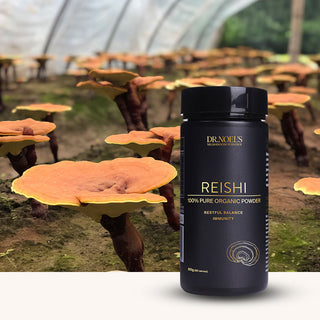
Dr Noel’s Organic Reishi Mushroom Extract Powder is a certified organic dual extract made from 100% fruiting bodies, with no added starch, mycelium or fillers.
Our published product specification lists at least 15% polysaccharides and at least 10% 1,3:1,6 beta-D-glucans. These are composition specifications, rather than a promise of a particular health outcome. We also explain why extraction matters when comparing mushroom powders.

Explore our organic reishi fruiting body extract
Read our ingredient specifications and product information, then decide whether it fits your needs.
Your questions about reishi fruiting body and spore powder
Is reishi spore powder a scam?
We would not label an entire ingredient category that way. Spores have their own chemistry. Our concern is with presenting a spore product as equivalent to a fruiting body extract without evidence for that comparison.
Does wall-breaking prove that spore powder is better?
No. It describes processing. It does not establish the finished product’s composition, absorption in people or clinical effectiveness.
Is every fruiting body extract a good product?
No. We still look for clear ingredient information, meaningful measurements and an explanation of quality testing. The words “fruiting body” are a starting point for questions.
When we choose reishi, we want the ingredient, the measurements and the explanation to agree. That is why our reishi extract starts with fruiting bodies, and why we encourage you to read beyond the headline.
This article provides general information, not medical advice. If you take medicines, have a medical condition, or are pregnant or breastfeeding, discuss a reishi supplement with a qualified healthcare professional before use. Follow the product label.
Sources and further reading
- United States Pharmacopeia: Ganoderma Lucidum Fruiting Body.
- China National Health Commission: 2023 additions to the food and Chinese medicinal material list (Chinese; PDF).
- Liu M-T, Chen L-X, Zhao J, Li S-P. Ganoderma spore powder contains little triterpenoids. Chinese Medicine. 2020;15:111.
- Wu D-T and colleagues. Evaluation on quality consistency of Ganoderma lucidum dietary supplements collected in the United States. Scientific Reports. 2017;7:7792.
Editorial inspiration: Lingzhi Origins, “Everyone Says Fruiting Bodies Are Better—Why Do Sellers Promote Spore Powder?”, 14 October 2026 (Chinese). This article is our own commentary on that question.