


Does research on ganoderic acid D mean reishi can protect memory when we sleep badly? A recent study gives researchers a reason to investigate that question further. It does not yet give people a proven reishi treatment for insomnia or memory problems.
At Dr Noel's, we want the difference to be easy to see. The study examined one named compound in aged rats exposed to chronic sleep deprivation. Its value lies in the specific behavioural and tissue findings, and in the questions those findings leave for future research.
The ingredient behind the headline
Ganoderic acid D is one of the triterpenoid compounds associated with reishi, also known as Ganoderma lucidum. In this paper, the abbreviation GAD refers to that compound. It should not be confused with a broad reishi extract or with reishi polysaccharides, which belong to a different chemical group.
This distinction becomes important as soon as someone tries to apply the research to a purchase. A study of ganoderic acid D does not tell us how much of it is present in every mushroom powder, or establish that a whole extract will produce the same result. The compound, preparation and exposure are part of the research question.
What the aged-rat experiment examined
The journal's official research abstract, published on 8 October 2026, describes 24-month-old male Wistar rats randomly allocated to four groups. There were 10 animals in each group, making 40 in total: a control group, a chronic sleep-deprivation group, and two sleep-deprivation groups receiving different doses of ganoderic acid D.
Compared with untreated sleep-deprived rats, the treated groups performed better on the Morris water maze. They reached the platform location more quickly and showed improvements in platform crossings and time spent in the target area. These are measures used to investigate learning and spatial memory in this experimental setting.
The researchers also examined the hippocampus. Their abstract reports less tissue injury and cell-death staining, lower malondialdehyde, and increases in the antioxidant-enzyme measures SOD and GSH-Px. It also reports higher expression of two proteins, SIRT3 and PGC-1α.
Taken together, those observations make this a study of behavioural performance alongside tissue-level changes. The abstract does not provide the detailed effect sizes needed to judge how large or consistent every improvement was.
Better maze performance is not the same as better sleep
The most important distinction may be the easiest one to miss. The reported work investigates consequences of experimentally imposed sleep deprivation. The outcomes described in the abstract concern maze performance and hippocampal measurements. It does not report a human insomnia trial or measurements showing that people fell asleep faster, slept longer or functioned better the next day.
That leaves two separate questions. Can a substance change what happens after sleep deprivation in an animal model? And can it safely improve a person's ongoing insomnia? Evidence for the first question cannot be treated as an answer to the second.
Nor can we turn a laboratory memory task into a claim that reishi prevents dementia. The subjects were aged male rats, the experimental conditions were controlled, and the intervention was a named compound. A result in that setting does not establish the same benefit across people of different ages, health conditions or medicine use.
What the pathway finding means
The researchers link their findings with SIRT3/PGC-1α signalling. Protein-expression measurements can help build an explanation for what happened in an experiment. However, observing higher protein levels alongside improved outcomes does not, on its own, establish that this pathway caused the improvement or was necessary for it.
We would therefore describe this as a possible mechanism supported by the reported associations. The journal abstract leaves further work to do. It should not become a promise that a consumer product “activates brain repair”.
Our reading also has a practical limit: the official abstract was accessible, but the full paper was not. We have therefore left out dosing instructions, treatment duration and detailed protocol claims that we could not independently check against the original methods. An animal experiment would not establish a consumer dose even if all those details were available.
Where our reishi powder fits
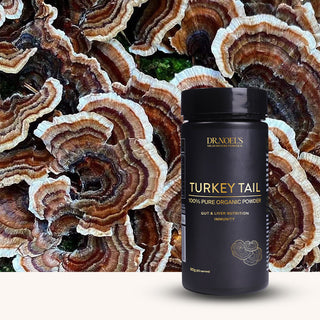
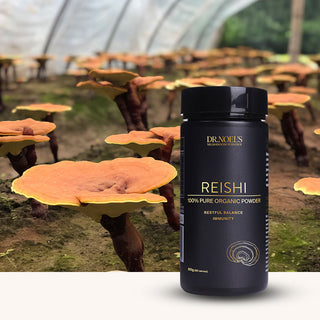
We sell Organic Reishi Mushroom Extract Powder, a dual extract made from 100% fruiting bodies, with no added starch, mycelium or fillers. Those are ingredient and preparation details that a shopper can check.
Our current published composition information lists at least 15% polysaccharides and at least 10% 1,3:1,6 beta-D-glucans. It does not state a ganoderic acid D amount. A beta-glucan percentage cannot establish a GAD concentration, because these describe different components.

We cannot claim that this experiment tested our powder or demonstrated a sleep or memory benefit for it. If you are comparing reishi ingredients, view our Organic Reishi Extract and read the current product details. If your question is about carbohydrate-based reishi compounds, our guide to reishi polysaccharide peptides explains that separate area of research.
If poor sleep is the problem you need to solve
Persistent insomnia deserves assessment in its own right. An Australian clinical review in Australian Prescriber recommends cognitive behavioural therapy for insomnia, or CBT-I, as first-line treatment. It also explains that sleep-hygiene advice alone is not equivalent to the full therapy.
For someone deciding what to do next, that is more directly relevant than a promising result in a rat maze. Speak with your GP about ongoing sleep difficulty and its daytime effects. If memory changes are also worrying you, raise those at the same appointment rather than using a supplement to explain or manage them yourself. Do not stop prescribed treatment because of this study.
Ganoderic acid D remains an interesting research subject. The useful next evidence would show whether findings translate into meaningful outcomes in people, using a clearly characterised preparation and an appropriate comparison. Until then, we can follow the science without turning it into a treatment claim.
Sources and reading scope
- Zhong L, Zhang S, Liu D, Ji Y. 灵芝酸D对老年慢性失眠导致的认知功能障碍的改善作用及机制 [Ganoderic acid D and cognitive dysfunction associated with chronic insomnia in aged rats; descriptive English rendering]. 解剖科学进展. Published online 8 October 2026. Official Chinese and English abstracts reviewed; full paper unavailable for this review.
- Ng L, Cunnington D. Management of insomnia in primary care. Australian Prescriber. 2021;44:124-128. DOI: 10.18773/austprescr.2021.027. Corrected clinical review; relevant full-text guidance reviewed.
Editorial starting point: a Chinese research explainer supplied by a reader, published by Junwu Jiankang (菌物健康) on 25 October 2026. We have developed an original consumer-focused interpretation and checked its central findings against the journal abstract. Product information checked on 5 November 2026. This article provides general education and does not establish a treatment recommendation.