

When a mushroom study makes the news, the details behind the headline matter. Was the work done in people? What preparation was tested? Does the result describe a health outcome, or a change in how an ingredient was extracted?
A 2026 paper on Reishi polysaccharides offers a useful example. It combines extraction research with an animal experiment related to Parkinson’s disease. The findings are relevant to further research, but the study does not establish a treatment benefit for people or for any retail mushroom product. [1]
What researchers mean by polysaccharides
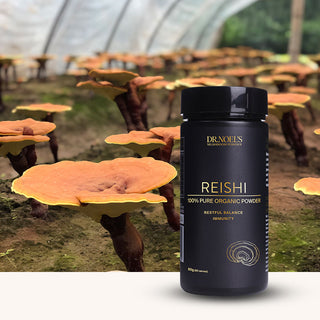
Polysaccharides are carbohydrates made from linked sugar units. Reishi, also known as lingzhi, contains these compounds, and researchers can extract them for study.
When reading a paper, it helps to identify the actual test material. A particular polysaccharide preparation, a broader mushroom extract and a whole mushroom powder should not be assumed to be interchangeable. The preparation and amount tested are part of the evidence, not minor details.
Two findings that answer different questions
The 2026 study, published in the Journal of Hefei University of Technology, examined a method that combines vacuum conditions with ultrasound. The researchers reported a polysaccharide extraction yield of 2.16%, which was 52.11% higher than the ultrasound-assisted comparison method under the study conditions. [1]
This is a result about extracting material. A 52.11% increase in yield does not mean a 52.11% increase in health benefits, absorption or product quality.
The researchers also tested the extracted polysaccharides in an MPTP-induced mouse model used to investigate aspects of Parkinson’s disease. Their abstract reports improved movement-related performance and reduced loss of dopamine-producing neurons in those mice. [1]
These results describe the animals and preparation studied. They do not show that Reishi restores lost neurons in people, prevents Parkinson’s disease or can replace prescribed treatment.
Why human studies remain essential
Animal experiments help researchers investigate biological effects under controlled conditions. Human trials answer a different set of questions: whether an intervention has a meaningful benefit for people, which dose is appropriate, and what harms or side effects occur. The FDA’s explanation of clinical research makes this distinction clear. [2]
Human research on Ganoderma extracts has been registered. However, two ClinicalTrials.gov records reviewed for this article had no posted results as of 4 October 2026. Registering a trial does not establish that a treatment works. [4] [5]
For a neurological condition, a useful trial would need outcomes that matter in daily life, an appropriate comparison group and enough follow-up to evaluate the question being asked. A short-term change in an experimental measurement cannot by itself establish a lasting clinical benefit.
The mouse study also cannot tell someone how much mushroom powder to take. Its findings should not be converted into a consumer dose or a reason to change medical care.
Four questions to ask about a mushroom headline
1. Who or what was studied? Check whether the evidence comes from laboratory work, animals or people. Each provides different information.
2. What exactly was tested? Look for the mushroom identity, the preparation, its composition and the amount used. A shared mushroom name does not establish equivalent effects.
3. What actually changed? Extraction yield, a biological marker, performance on an animal test and improvements in a person’s symptoms are different outcomes.
4. How strong is the comparison? Look beyond whether a result was called statistically significant. Consider the size of the effect, study design, limitations and whether independent research supports it. [2]
Keeping the findings in perspective
The most useful reading of this Reishi paper is specific: it reports an extraction improvement and findings in a mouse experiment. It leaves the clinical questions open.
Parkinson’s disease needs individual medical care. Established treatments can help manage symptoms, and treatment decisions should be made with a qualified clinician. Do not stop or replace prescribed medicines because of a mushroom study. If you are considering a supplement, discuss it with your doctor or pharmacist. [3]
Good mushroom education makes it easier to see what a study shows, what it leaves unanswered and what evidence would be needed next.
Sources
1. Zhu M, Li Q, Wu S, et al. (2026). Study on vacuum-coupled ultrasonic extraction optimization and anti-Parkinson’s disease activity of Ganoderma lucidum polysaccharides. Journal of Hefei University of Technology (Natural Science), 49(8), 1135–1140. Journal abstract. DOI: 10.3969/j.issn.1003-5060.2026.08.019. Read the journal abstract
2. US Food and Drug Administration. Step 3: Clinical Research. An explanation of human trials, study design and the distinction from preclinical research. Read the FDA guide
3. National Institute of Neurological Disorders and Stroke. Parkinson’s Disease. Information about symptoms, treatment and medical care. Read the NINDS overview
4. ClinicalTrials.gov. Registry record for trial NCT00224263 of Lingzhi in Parkinson’s disease. No results posted when checked on 4 October 2026. Read trial NCT00224263
5. ClinicalTrials.gov. Registry record for trial NCT03594656 of Ganoderma lucidum in Parkinson’s disease. No results posted when checked on 4 October 2026. Read trial NCT03594656