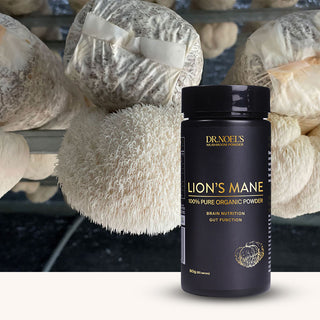


When a paper studies lion’s mane, the test material may be a purified molecule rather than a mushroom. That small detail changes how we should read the result.
Polysaccharides are one part of the chemistry of lion’s mane, Hericium erinaceus. Researchers have separated and studied many of these complex carbohydrates. Understanding what they tested, and how, is more useful than treating every finding as a benefit of every lion’s mane product.
What are lion’s mane polysaccharides?
Polysaccharides are long chains of sugar units. Their properties depend on which units are present, how they are joined and whether the chains have branches. The term describes a broad family of substances, rather than a single ingredient with one fixed structure.
Some lion’s mane polysaccharides are beta-glucans, which contain glucose units joined by beta linkages. Others contain a mixture of sugars. For example, one research team separated five polysaccharide fractions from fruiting bodies, while another characterised a branched beta-glucan obtained using alkaline extraction. Both studied lion’s mane, but they were working with different materials. Yang and colleagues, 2022; Qiao and colleagues, 2024.
Where do hericenones and erinacines fit?
Lion’s mane also contains compounds called hericenones and erinacines. These are chemically distinct from polysaccharides. Hericenones have been isolated from fruiting bodies, and erinacines from cultured mycelium, the fungus’s network of growing filaments. A paper about one group cannot automatically support a claim about another. Wang and colleagues, 2025.
This distinction matters when reading a headline about “lion’s mane research”. The species name alone does not identify the compound, preparation or biological question being investigated.
Three ways scientists investigate polysaccharides
Measuring responses in cultured cells
A 2022 study examined isolated polysaccharide fractions in laboratory cell models. Its experiments included mouse-derived macrophages, a type of immune cell, and a co-culture system combining these with an intestinal epithelial cell line. The researchers measured signalling molecules and cytokines, the chemical messengers involved in immune responses. Read the original study.
These measurements help scientists investigate mechanisms. They do not show that consuming a mushroom powder prevents illness or improves someone’s immunity. Even when a model includes human-derived cells, it remains a cell experiment rather than a trial in people.
Testing chemical reactions
In a 2024 study, researchers isolated a beta-glucan called AHEP-A-b and tested it in several radical-scavenging assays, including DPPH and ABTS. These tests measure chemical reactions under defined laboratory conditions. Read the original study.
An “antioxidant” result in this setting needs that context. It does not measure a person’s energy, wellbeing or long-term health, and a percentage reported in an assay cannot be read as a percentage improvement in the body.
Studying a whole animal
A 2022 study investigated a lion’s mane polysaccharide preparation in rats with experimentally induced gastric injury. The researchers also characterised one fraction, RP-S, as a branched beta-glucan. Read the original study.
Animal models allow researchers to study interactions that a test tube cannot capture. Their findings still require testing in people before conclusions can be drawn about human treatment. The study’s preparation and experimental conditions also matter.
Why the preparation matters
A whole mushroom powder, an extract and a purified polysaccharide fraction have different compositions. In the studies above, researchers used extraction and separation procedures to obtain the materials they wanted to investigate. Their findings belong to those materials and methods.
The same caution applies to chemically modified polysaccharides or experimental delivery systems. A substance altered or formulated in a laboratory should not be treated as equivalent to an ordinary mushroom ingredient.
A useful reading habit is to look for the material’s full description in the methods section. A short code such as “HEP” is only a study label; it is not enough to establish that two papers tested an identical preparation.
Four questions to ask about a research headline
- What was tested? Look for the mushroom part, extraction method and whether the material was a mixture or an isolated fraction.
- Where was it tested? Distinguish chemical assays, cultured cells, animals and human participants.
- What was measured? A change in a laboratory marker is a different outcome from a meaningful improvement in someone’s health.
- How far does the conclusion reach? Check whether the headline goes beyond the preparation, participants or outcomes in the study.
What to take away
Lion’s mane polysaccharide research offers detailed questions about molecular structure and biological activity. The examples here show why the experimental details are essential: different fractions, models and measurements answer different questions.
These selected studies do not establish health benefits for an ordinary lion’s mane powder in people. Reading the methods alongside the headline helps keep scientific curiosity grounded in what the research actually tested.